
What People Really Want Inked in 2026
The Expert Take: What Americans Actually Search for When They’re Ready to Get a Tattoo
Google search data doesn’t tell the whole story of what ends up on skin, but it does reveal what people are thinking about when they start the process. The Google Trends data covering roughly the past 12 months show a clear pattern: Americans are overwhelmingly searching for simple, meaningful, and emotionally direct designs.
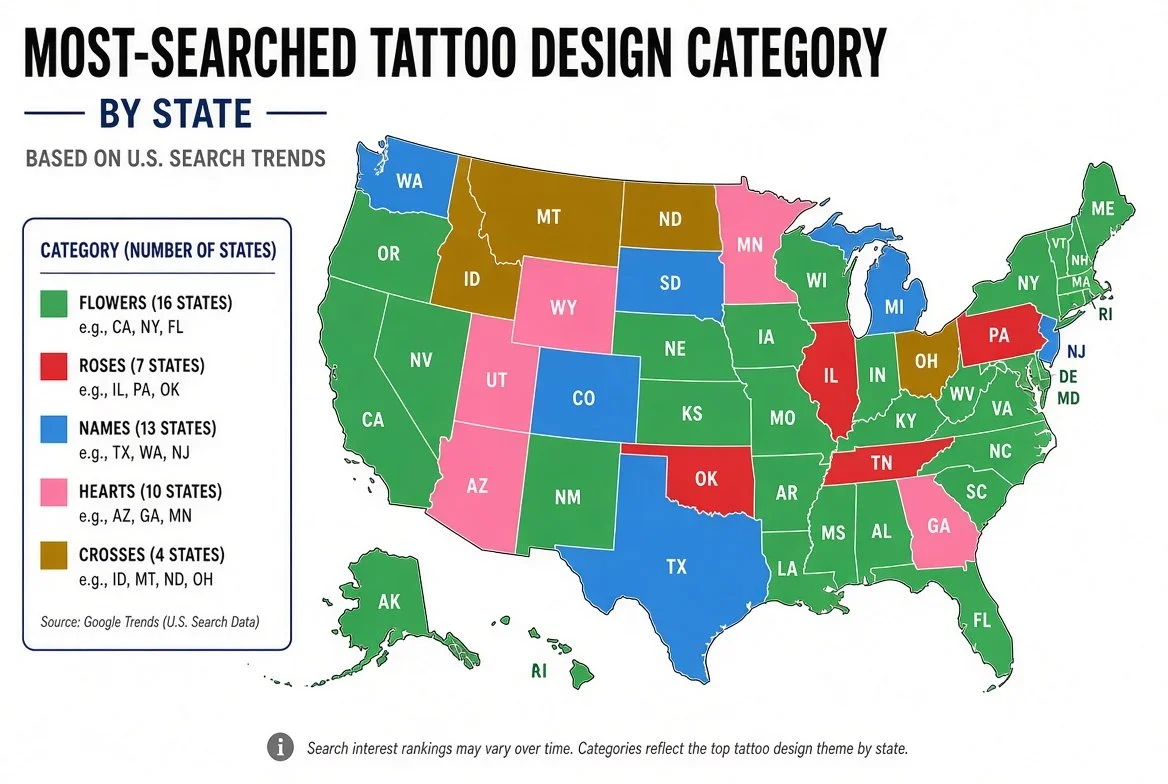
Here’s the breakdown by category:
Flowers lead in 16 states: California, Utah, Nebraska, Iowa, Missouri, Kentucky, Michigan, West Virginia, Virginia, North Carolina, Florida, Maryland, New York, Massachusetts, Vermont, and Maine.
Roses specifically lead in 7 states: Wyoming, South Dakota, Oklahoma, Illinois, Indiana, Pennsylvania, and Rhode Island.
Names lead in 13 states: Washington, Oregon, Nevada, Colorado, Texas, Arkansas, Louisiana, Mississippi, Tennessee, South Carolina, Wisconsin, New Jersey, and Delaware.
Hearts lead in 10 states: Alaska, Hawaii, Arizona, New Mexico, Kansas, Minnesota, Alabama, Georgia, Connecticut, and New Hampshire.
Crosses lead in 4 states: Idaho, Montana, North Dakota, and Ohio.
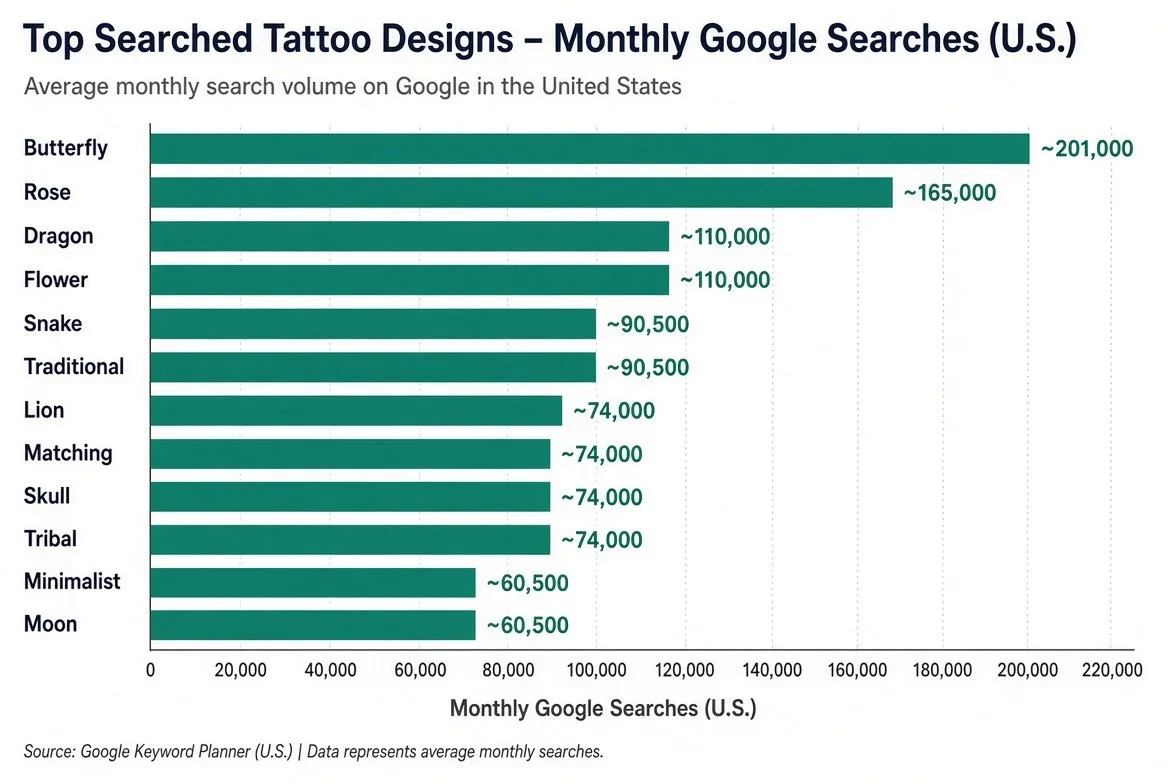
Nationally, the highest-volume design searches look like this:
Butterfly: ~201,000 monthly searches
Rose: ~165,000
Dragon: ~110,000
Flower (general): ~110,000
Snake: ~90,500
Traditional: ~90,500
Lion, Matching, Skull, Tribal: ~74,000 each
Minimalist and Moon: ~60,500 each
Script-related searches sit lower but remain consistent: Bible verses/scripture (~18,500), word tattoos (~14,200), name tattoos (~4,500), and significant dates (~4,300). Search interest for both new tattoos and tattoo removal reliably peaks in summer and drops in winter. Local “tattoo shop near me” style searches have also grown, especially across the South and Southeast.
What This Data Actually Means
From the studio side, these numbers line up with what clients bring in, with a few important caveats.
Flowers and roses dominate because they are flexible. They can be small and delicate, large and detailed, black and grey, or full color. They carry recognizable symbolism (love, beauty, resilience, growth) without requiring the client to explain a long personal story. A rose or floral piece is also one of the easier designs for a skilled artist to elevate—adding realistic shading, texture, or surrounding elements turns a basic search into a custom tattoo that still feels personal.
Names and hearts are even more direct. Name tattoos are almost always about a specific person (a child, partner, parent, or someone lost). Hearts function the same way. These pieces tend to be smaller and more intimate in placement. The risk is obvious: names and relationships change. A good artist will have an honest conversation about longevity and placement before the stencil goes on.
Crosses cluster in a handful of states and usually reflect faith. Like names, they are personal, but they also age cleanly when done with solid line weight and proper contrast.
The high national numbers for butterflies, dragons, snakes, and lions show that people still want recognizable symbols with built-in meaning (transformation, strength, danger, protection). Minimalist and moon designs reflect the fine-line wave that has dominated social media for several years. Traditional and tribal searches indicate that classic styles never fully disappear—they just cycle in and out of peak interest.
The Gap Between Search and Studio
Search data captures intent, not execution. A lot of people searching “butterfly tattoo” or “rose tattoo” will end up with something more customized once they sit with an artist. Many of the fine-line and micro-realism pieces that fill Instagram feeds started as basic searches. Portraits (especially pets and family members) don’t always rank as the single top search in a given state, yet they remain one of the highest-skill, highest-demand categories in high-end studios because the emotional stakes are higher and the technical demands are greater.
Seasonality is real. Summer drives more walk-ins and shorter-notice bookings. Winter is when larger custom projects and cover-ups tend to get planned. Local search growth means clients are increasingly looking for artists in their own area rather than traveling for a specific style—unless the artist has a strong national reputation in realism, portraits, or another specialized category.